
'To the believers of crypto regulations, I have only one question to ask, how will you regulate it?'

Unless unique, avoid investing in IPOs.

Shares of Adani Group firms continued to remain weak for the seventh day running on Friday amid a host of negative events surrounding the companies. The stock of Adani Enterprises tumbled 20 per cent to Rs 1,173.55 -- its one-year low -- on the BSE. Shares of Adani Ports tanked 10 per cent, Adani Transmission (10 per cent), Adani Green Energy (10 per cent), Adani Power (5 per cent), Adani Total Gas (5 per cent), Adani Wilmar (4.99 per cent), NDTV (4.98 per cent), ACC (4.24 per cent) and Ambuja Cements (3 per cent).
'When a company goes into insolvency, by definition it means that existing shareholders have been wiped out.'
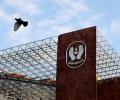
For the initial public offering (IPO) of the Life Insurance Corporation of India (LIC), the Centre has shortlisted 50-60 anchor investors, which include BlackRock, Sands Capital, Fidelity Investments, Standard Life, and JP Morgan, and will soon finalise its anchor book. The feedback from anchor investors has led to price discovery in LIC shares, valuing India's largest insurer at around Rs 7 trillion, said an official aware of the development. The "attractive valuation" is seen widening the investor base by providing an opportunity to more of them to participate in the IPO, the official added.
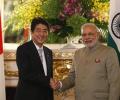
The commitment by Japan to invest $35 billion or 3.5 trillion YEN is for infrastructure sector over five years.

Global private equity investor Advent International on Monday said it is acquiring a significant stake in Suven Pharmaceuticals from its promoters, the Jasti family. The PE major said this will be followed with an open offer to acquire 26 per cent more in the listed contract development and manufacturing organisation from public shareholders, and also merge the company with investee company Cohance Lifesciences, as per an official statement. Media reports on a Monday morning pegged the acquisition at Rs 6,300 crore, and that Advent had pipped rival Blackstone for the acquisition.

The result is a big blow to the military establishment, revealing the limits of 'political engineering'. It reflected the anger of the electorate, especially its younger voters, who have spoken decisively against the persistent harassment and victimisation of Imran Khan's political party, asserts Rana Banerji, who headed the Pakistan desk at RA&W.

In its set of recommendations, the China Committee said that economic sanctions against China in case of an attack on Taiwan will be most effective if key allies such as G7, NATO, NATO+5, and Quad members join, and negotiating a joint response and broadcasting this message publicly have the added benefit of enhancing deterrence.

'...similar to the 2008 global financial crisis, the 2012 taper tantrum, or the 2018 midcap crash.' 'This could lead to a substantial decline in activity and revenues for the broking industry.' 'When this will happen is uncertain, but as brokers, we must be prepared for such a downturn.'

After dropping to a low of Rs 1,298 apiece, the stock finished at Rs 1,380, its lowest level since November 22, the second day of listing.

State Tourism Minister Bratya Basu said that Chief Minister Mamata Banerjee had directed the Tourism Department to go ahead with the setting up the board.
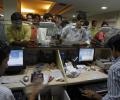
The government will not bring down its ownership in public banks.

Capital expenditure by 54 large central public sector enterprises and five departmental arms, having a capex minimum target of Rs 100 crore, rose 93 per cent year-on-year (YoY) in the April-May period to Rs 1.39 trillion. The National Highways Authority of India (NHAI) and the Railways have started this financial year's capex cycle on a stronger note. In the first two months of FY24, the 54 CPSEs, along with the departmental arms, achieved 19 per cent of their combined budget target of Rs 7.33 trillion, Business Standard has learnt.
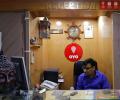
Hospitality firm OYO is planning to raise up to $1.2 billion (around Rs 8,000 crore) through an initial public offering and is expected to file the draft red herring prospectus with Sebi next week, sources told PTI on Thursday. OYO has appointed investment banks like JPMorgan, Citi and Kotak Mahindra Capital to manage its public issue, they added. Comments from OYO could not be obtained at the time of filing the story. The proposed initial public offer (IPO) plan of the hospitality firm follows the spectacular success of Zomato's IPO that ended with a bumper oversubscription on July 16, and was biggest since March 2020.

'Revision of the base year for both CPI and GDP are long overdue.' 'The basic data that went into the 2011-2012 series were mainly from surveys done in 2011 or earlier.' 'We have since seen the emergence of new sectors like platform-based work and online marketing.' 'The employment surveys and the consumption surveys need to reflect these adequately.'

Three marquee exits accounted for nearly 60 per cent of the total exit value -- BillDesk's acquisition by PayU for $4.7 billion, Paytm's $2.5 billion initial public offering (IPO), and Zomato's public market debut of $1.3 billion.
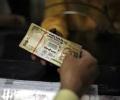
Public resources are scarce and need to be used well.

At the World Bank Banga will be replacing David Malpass, a former Trump treasury official, reports axios.com. Malpass had already announced that he will resign by July, months ahead of his term expired. "Ajay is uniquely equipped to lead the World Bank at this critical moment in history," President Biden said in a statement. Banga, 63, currently serves as vice chairman at General Atlantic.

More than a dozen entities, both domestic and foreign, had come under the regulatory glare over alleged short-selling before and after the publication of the Hindenburg research report against Adani Group, two people familiar with the development said. The Securities and Exchange Board of India (Sebi), which is examining the rise in stock values of Adani Group in the past few years, is also scrutinising the trade data and trade pattern of these entities allegedly involved in short-selling and made significant profit. Enquiries in the trade pattern of these entities reflected a profit of over Rs 30,000 crore, pre- and post-Hindenburg saga, said one of the two people.
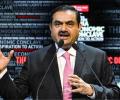
Adani Enterprises on Wednesday said it has decided to withdraw its fully subscribed Rs 20,000-crore follow-on public offer (FPO) and will return the proceeds to investors. The announcement came a day after the company's FPO was subscribed fully on the last day of the offer on Tuesday. "The Board of Adani Enterprises Ltd., (AEL) decided not to go ahead with the fully subscribed FPO.

'There are problems related to the Indian film industry that I'd like to address rather than to keep harping on the negative zone of hurdles in film certification,' Minister for Information and Broadcasting Rajyavardhan Rathore tells Subhash K Jha.
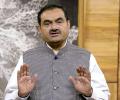
Six entities including four foreign portfolio investors (FPIs) are under lens for suspicious trading in Adani group shares prior to the release of the damning Hindenburg report, the Supreme Court-appointed expert committee has said. There was a build up of short positions in the Adani scips prior to the January 24 release of the Hindenburg report, and substantial profits were booked thereafter as stocks crashed, the 178-page report said. A "short" position is generally the sale of a stock one does not own.

The initial public offering (IPO) market has seen some momentum of late with robust responses to recent issues. However, only some have been able to ride the wave. So far in 2023, 23 companies have let their approval granted by the markets regulator - the Securities and Exchange Board of India (Sebi) - lapse.
Embattled billionaire Gautam Adani on Thursday spoke publicly for the first time since his ports-to-energy conglomerate publicly battled a short seller's accusation of stock manipulation and accounting fraud, saying the abrupt move to withdraw a fully-subscribed share sale at his flagship firm was due to market volatility. His group continued to lose on the stock market, with the cumulative rout now nearing $108 billion in a week -- one of the biggest wipeouts in India's history. "After a fully subscribed follow-on public offering (of Adani Enterprises Ltd), yesterday's decision of its withdrawal would have surprised many.

The Congress-led opposition stepped up its attack on Friday against the government over the Adani row and demanded that there should be a thorough investigation into what they alleged was a 'mega scam' as it involved public money.

Having successfully executed the merger with parent HDFC, HDFC Bank's managing director and chief executive Sashidhar Jagdishan on Saturday said the country's largest lender aims to double every four years. In a letter to the over 4,000 employees from HDFC who joined the bank's rolls on Saturday, Jagdishan said the future is bright, and the work on realising the potential of the merger starts now. "The runway for financial services and mortgage, which are so underserved and under penetrated, is going to be very large. HDFC Bank - the combined entity - with a large and growing distribution and customer franchise, more than adequate capital, healthy asset quality and profitability, will be best positioned to capture growth.

The Budget for 2016-17 has announced a massive rollout of ATMs and micro-ATMs.

Mutual funds, as experts and custodians of another set of retail investors' savings, play a speculative game they are neither supposed to nor equipped to do, cautions Debashis Basu.
Bad loans of PSU banks rose by 28.5 per cent.

More than Rs 8 crore unaccounted cash has been seized in subsequent raids at various locations by Lokayukta. The arrested officer's father is Madal Virupakshappa, the MLA representing Channagiri constituency in Davangere district of the state.

Sebi has said investment banks should direct investors to original sources such as stock exchanges, where data is publicly available.
Billionaire Gautam Adani-led group's renewable energy firm on Thursday announced plans to raise Rs 12,300 crore through a share sale to investors as the group continues to build on a comeback strategy to emerge out of allegations of fraud levelled by a US short-seller. Adani Green Energy Ltd in a stock exchange filing said its board has approved raising up to Rs 12,300 crore through an issue of equity shares by way of qualified institutional placement (QIP). The funds are intended to be used for meeting capital needs of the company's expansion plans.
.jpg)
At the retreat, PSBs had suggested the government cut its stake in these entities to less than 51 per cent over a period of time and empower the boards of individual banks.

The move comes within months of a crisis at JPMorgan Asset Management Company.
Be wary of co-operative banks which have historically been most vulnerable.
Weeks after it revised the rating outlook of two companies of embattled Adani group, S&P Global Ratings on Wednesday said it is watching for additional information on the conglomerate's governance and funding for any ratings action. Investors, it said, seek clarity on the credit impact of a string of allegations against the group in a short-seller report published in late January, and on the findings of a recently launched Supreme Court investigation. S&P Global published an FAQ-style commentary titled, "Adani Group: The Known Unknowns".
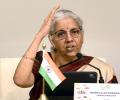
'I'm pitching India for the strengths we offer, including the English language, engineers, doctors, nurses, professionals, innovative talent of startups.'

Ms Usha may soon discover that winning four gold medals at the Asian Games and qualifying for the Los Angeles Olympics is a walk in the park compared with the challenges of stabilising governance at the IOA, observes Kanika Datta.

Every banker loves the four-letter word Casa as it plays an important role in lowering the cost of deposits. Every bank wants to increase its Casa, as a higher portion of Casa in the overall deposit liability brings down its cost of money, points out Tamal Bandyopadhyay.
